

This penny-saving challenge brought my debt-free date forward by 6 months.
My time working for a debt charity opened my eyes to how precarious our financial stability can really be. Earning a decent wage with an affordable mortgage and a couple of credit cards on the go seems pretty standard, right? Except, just one ‘bad situation’ that requires you to fork out can cause serious damage. Even more so for those living alone and renting their homes. Getting into debt is what people do when they’re ‘bad with money’. Nope! We could all be one problem away from getting ourselves into a financial hole.
Fresh out of university 14 years ago, I ran straight into an internship in London that paid me £50 a week to cover my travel expenses. My travel card, however, cost me £52 a week (and rising annually.) So further into my student overdraft I headed. Eventually, I was promoted from desperate intern to a real life writer. I had my own desk, business cards, a byline … and a grown-up overdraft. No more fee-free student account. Yikes.
I got used to living in my overdraft and in truth, I’d given up on ever really getting out of it. I wanted to spend my big girl writer salary in Topshop and order shoes on Net-a-Porter. I ended up getting a credit card to buy things that I wanted and the rest is (credit) history.

My low salary and passive attitude towards my finances were two unstable carriages on a runaway train headed for a cliff. Eventually I ended up with around £5,000 in credit card debt and a £2,000 overdraft.
Enough was enough!
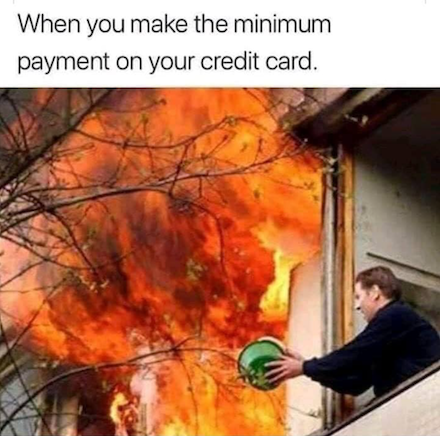
My debt followed me through getting married, moving across the country, and getting a mortgage. At each stage I was terrified my plans would be ripped away or my debt would double. One of my credit cards had almost £2,000 more debt than I thought due to interest I didn’t know I was being charged. I just blindly paid the minimum repayments offered each month and figured that was how it would be paid off. I had nightmares about being turned away in shops and would hold my breath tapping my bank card to pay for food in case it wouldn’t go through. Enough was enough.
I made a plan to hop my debt across 0% balance transfer cards to ensure I kept as interest-free as possible while I repaid. When an old card was empty, I would close the account to keep the number of active cards low and help my credit score recover. Things started to feel more manageable and I was slowly reducing my overdraft by selling old clothes and meal planning. FYI – card-hopping isn’t an instant solution to debt and you should always research before opening new accounts.
It was going to take me almost five years to pay off every single penny of my debt. I was slowly chipping away at the balance, but it was frustrating. I stopped opting into repaying the ‘minimum amount‘ and set a fixed monthly amount for each card. This meant the debt was actually being reduced and I was paying less in total interest. Until this debt was paid off, I felt like my past struggles were still hanging over me.
It was in 2017 that I realised there was a way to get this debt paid off quicker than I planned. I had started working at a debt charity and discovered there were loads of money-saving and debt bloggers sharing their tips for people in crisis. I looked up Skint Dad’s penny-saving challenge and decided I would give it a go.
How does the penny-saving challenge work?
The idea is to save money for a whole year, but here’s the twist; the amount of pennies you put away each day will gradually increase. So, for day 1 you’d save 1p. Then on day 2 you’d save 2p, day 3 saving 3p – and so on. By the end of the year you’d save almost £700. It meant the concept of saving didn’t feel overwhelming or impossible, and I could save while continuing to repay the debt.
Most people doing the challenge use physical cash in jars or folders so they can see their savings each day they put it away. But I knew this approach wouldn’t work for me as I don’t carry cash and struggle to keep up with daily challenges! Instead, I used Skint Dad’s spreadsheet and calculated how much I’d need to move into my savings account every month of the challenge. As soon as I got paid, I moved the cash I needed to save that month into another account and watched my savings build up. It was a great feeling!
The moment of truth…
Towards the end of the year, I dared a peek at my credit card balance. By repaying a fixed amount each month, I had actually made good headway towards clearing it! I worked out that I might be able to pay off all my debt 6 months earlier than planned if I used the penny-saving money to pay a big chunk off there and then. It meant I could be debt-free by March 2019 and use the following 6 months to put some additional savings away ready for a career change in the September. It felt so important that I got rid of the debt before I took on my year’s unpaid training.
It felt amazing to finish the Skint Dad challenge once I got paid in December, and on the 1st January 2019 I cleared £700 off my credit card. Watching that balance reduce by that much felt so freeing and I was beginning to feel very proud of myself for sticking with the repayments and the saving challenge on top. I still needed to make those regular payments to close the balance by March 2019, but knowing that very soon I could say I was debt-free was more than enough motivation!
Finally, that March I made my very last repayment and I became officially consumer debt-free (except for my student loan, but we don’t really count that do we.) I’ve not applied for or used a credit card since, and I’m very lucky that my overdraft has never been seen again. Result!
What I’d do differently…
If you’re thinking about taking the Skint Dad challenge to help you pay off some debt, here’s something I’d change if I were to do it again.
If you follow the challenge to the letter, you’ll notice that towards the end of the year you’re obviously putting larger chunks of money away. This might be a struggle when you start to factor in costs such as Christmas or summer holiday childcare. I’d swap a few of the months around and save some of the larger amounts in the middle of the year. It makes those seasonal expenses much easier to cover.
The challenge lets you see saving in a ‘little and often’ way, rather than struggling with putting away, say £100, every month. While the savings in the later months are bigger, you’re well into the process by then and can make adjustments in the earlier months if you think it’s going to be a struggle later.
In debt? There is always help…
If you’re struggling with debt or unsure where to even start sorting it out, you’re not alone. Get in touch with StepChange: accessed only on stepchange.org (there are some nasty scamming imitators out there!) for free practical advice and support. You can call them and speak to an advisor, or you can use their online debt advice tool. While some debt solutions include fees, never pay to receive debt advice. Places like StepChange and Citizen’s Advice are free to access and full of knowledgeable advisors.
Featured image by Sarah Agnew on Unsplash.


 Slower Living | Learning to live slowly